Why Teach Creative Writing? or, Why Teachers Should Have the Chance to Be Writers.

Working with other teachers who love to write has been one of the greatest pleasures in my career. After several years of leading workshops for teachers with the Greater New Orleans Writing Project and for the Kenyon Review Writers Workshops, and thinking about some old and new challenges in the classroom, I now think that more teachers should have the opportunity to practice creative writing. Here are some of my thoughts about why this is something schools should encourage and offer not only for the English/ELA faculty, but for teachers across the curriculum. [Note: this is very much a draft, and I welcome any constructive feedback.]

Creative thinking is critical thinking. Creative thinking entails a willingness to be surprised, which itself requires a capacity to embrace not-knowing. As Donald Barthelme puts it in his essay, “Not-Knowing,” “The writer is one who, embarking upon a task, does not know what to do.” When we begin drafting a poem or story, it will only turn out as something original, something truly our own, if we don’t know where it will lead. Genuine critical thinking is no different: it requires a willingness to follow analysis and interpretation in directions that may not only be unexpected, but that change the premises and assumptions we may have had when we embarked. All of this is true even when writing about ourselves. The guiding question for Michel de Montaigne, the 16th-century writer who created what we now call the personal essay, was, “What do I know?”

Creative writing and thinking rewards what AI cannot. Widely reported results from a University of Pennsylvania study (see, for instance, “Kids Who Use ChatGPT as a Study Assistant Do Worse on Tests,” Jill Barshay, Hechinger Report, 9/2/24) make clear that AI poses real and immediate risks to learning, especially among young people. AI rewards the desire to complete a task with minimal effort—not unreasonable, but not a starting place for learning. In fact, students who rely on AI to write a paper are using it to replace learning altogether. The fact that that’s even possible makes AI different from other tools. A calculator, for instance, requires some understanding of mathematical concepts in order to use it effectively. Creative writing rewards learning by giving immediate satisfaction for making something fun and interesting with language. It can also be approached as a game, which offers not just the rewards of winning but of enjoying play and imagination. If students can find those kinds of rewards through writing, they are more likely to value other kinds of original thinking—and to appreciate the learning that comes with it.

Teachers who model writing for their students are highly effective. Nothing makes me sadder than hearing someone say, “I can’t write.” Likewise, few things make me happier than setting someone up with a writing activity and seeing their excitement and satisfaction when they realize that yes, they can write—even if they’ve never written a poem or story before. As a teacher, I’ve always done the same writing activities I give my students and workshop participants, and I share my work with them. Seeing that I take the work seriously encourages them to do the same. In fact, that usually makes more of an impression than if I rattle off all my publication credits. Being genuinely receptive to their feedback on what I’ve written is also a great way to encourage them to take my feedback and that of their peers more seriously. In the best case, you end up with a room of mutually supportive writers—in short, a writing community. And that is a powerful thing.

Creative writing makes writing pleasurable, as it should be. I believe most people who don’t think they can write have never had a reason to enjoy writing. Writing should be fun. Even when we’re writing about difficult material, or writing in a challenging form such as a sonnet, if the process itself does not offer some kind of pleasure (from an imaginative discovery, from finding the right word, from shaping a sentence so it says what you want in the way you want), then why wouldn’t it seem like a chore? If we want students to find pleasure in writing, I firmly believe we need to have authentic experiences of enjoying writing for ourselves.
Upcoming Reading with Ed Madden and Kevin McLellan, 4/20/23

I’m delighted to be reading virtually for Malaprop’s Bookstore and Café with Ed Madden and Kevin McLellan. Their new books (A Pooka in Arkansas and in other words you/, respectively) were chosen by Timothy Liu as the 2022 additions to the Hilary Tham Capital Collection from The Word Works. It’s been a pleasure to bring these books into the world, and I hope you’ll join us for this reading.

Here’s the link for the reading: https://www.malaprops.com/node/47992

And here are the IndieBound links for my books:

Butcher’s Sugar: https://www.indiebound.org/book/9781937420253https://bookshop.org/p/books/butcher-s-sugar-brad-richard/10975984?ean=9781937420253

Motion Studies: https://www.indiebound.org/book/9780915380787https://bookshop.org/p/books/motion-studies-brad-richard/9457171?ean=9780915380787

Parasite Kingdom: https://www.indiebound.org/book/9781944585280https://bookshop.org/p/books/parasite-kingdom-brad-richard/8896879?ean=9781944585280

Many thanks to Stephanie Jones-Byrne, Director of Marketing and Author Events at Malaprop’s, for all her help in making this happen!

Imagining 9/11

Of course I remember 9/11. I have nothing to add to that, no interesting or meaningful anecdote. I was horrified, saddened, and appalled by everything about the attacks and their aftermath–which means I was also horrified, saddened, and appalled by the world we mostly chose not to believe we were living in beforehand, the world we had made, the world of consequences.

I’ve left the “we” unspecified in that paragraph, just as I left most first person pronouns, singular or plural, more or less ambiguous throughout Parasite Kingdom. That was a consequence of 9/11 for me: a book in which individual identities briefly cohere, then disperse or explode. Some–the more mythic ones, like the Wasp herself–manage to seem more stable, more durable, but that’s an illusion that keeps archetypes alive. The Wasp, too, can be unimagined, the way Al-Qaeda unimagined the towers, the way we (there I go again) unimagined every uncolonized person we encountered and called it “history,” until there was no way we would not experience an “unimaginable” consequence.

(For those who haven’t read it: in Parasite Kingdom, a mythically gigantic blue wasp lives in a nest beneath the palace of her nemesis, a petty despot. The Kingdom is at war–with itself and maybe with external enemies. The Wasp is also the subject of a cult in the kingdom. The book isn’t exactly a narrative, but those are some basic facts of its narrative universe.)

Parasite Kingdom wasn’t the only thing I worked on in the years after 9/11. I had already written one book (Butcher’s Sugar) and would soon start another (Motion Studies–also motivated by a disaster), both of which would be published long before Parasite Kingdom. That was largely because I kept putting it off. I hated spending time in that kingdom, hated it. But I kept coming back until I finally finished it, spurred in part by the events of 2016. (It’s all of a piece.)

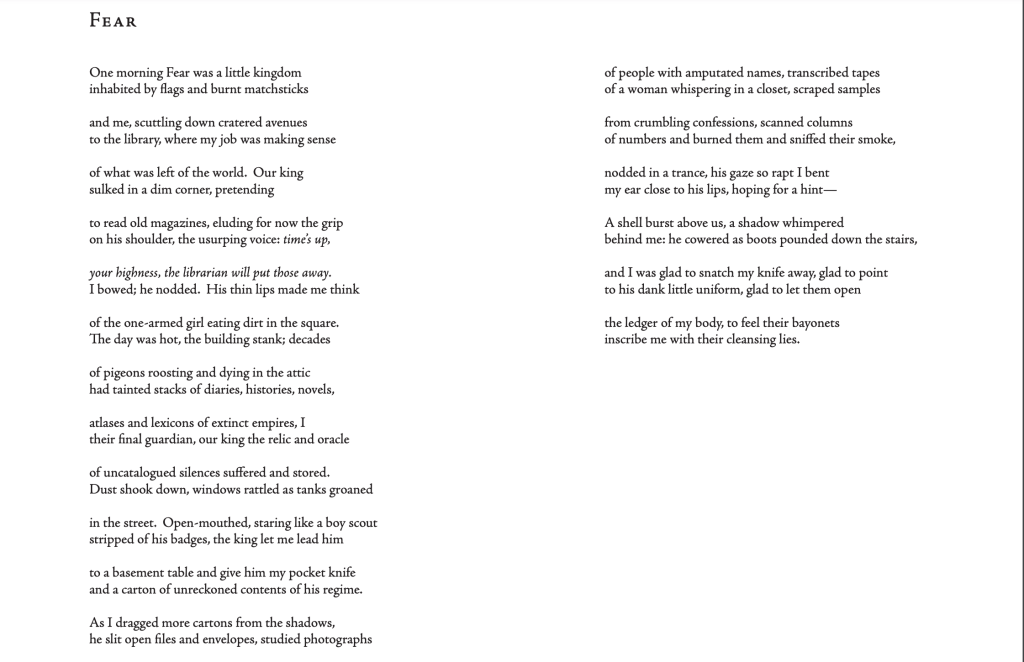
“Fear” was the first poem I was able to write after 9/11 and the first poem that would lead me toward Parasite Kingdom. In those weeks, there was a classroom window my colleagues and I used to stand at, staring dumbly at an old brick building behind us. It seemed like that roof was being repaired for centuries, like repair was something that no one could complete. As I stood there brooding, my imagination re-worked horror and despair into something I could manage, and this poem finally came to me. I had no idea what it would lead to.

Many thanks to Witness, where “Fear” originally appeared, and to The Word Works, with very special gratitude to Leslie McGrath (1957-2020), founding editor of the Tenth Gate imprint.

Never Say Never

It’s a simple enough anecdote, barely even that: I was cleaning, I found something, memories and emotions returned. If only it were that simple:

I was cleaning because I needed relief, first from pandemic claustrophobia, and second from the guilt of having moved into this house ten years ago with things that were never properly sorted out from our old house. We did make room for things: we spent the time and money to have shelves built for my books, including a floor-to-ceiling bookcase in my study, just for poetry books. I didn’t have enough to fill it then, so I had a lot of empty shelf space that I could justify as “other storage”: odd paper products, books that didn’t really fit into categories elsewhere in the house, and items that I didn’t know what to do with but would decide later. Or never. Of course, over ten years, those spaces became like Gregor’s room in “The Metamorphosis,” a place for junk I didn’t really want to see or acknowledge. Very cluttered, very dusty, possibly harboring vermin.

Well! Now that I’ve been trapped like Gregor in this house for a year, it seemed high time to purge some things and reclaim those shelves for books that needed the space. Among the old printer cartridges and teacher memorabilia and strange detritus from various research projects, I found a spindle of CDs. “Found” isn’t really the right word: I was well aware of it, had seen it every time I’d added something new to my little charnel house, but couldn’t wrap my head around going through those dozens of discs and deciding which would be saved and which consigned to . . . wherever unwanted CDs go.

Most were labeled, a few not. This morning, I grabbed a couple of the unlabeled ones to check out in the car while I was running errands. A few days ago, I found a nifty mix I’d made, lots of ridiculous stuff from the aughts, most of it best forgotten. Still, it was nice to play it one last time. So, maybe one of these mystery CDs was something like that.

The first one was actually blank. Bummer—no mystery, nothin’. I popped in the second one, and almost as soon as “The Politics of Dancing” started playing, I was laughing. By the time I got to “The Look of Love” and was on the expressway, I was in tears. This was one of several CDs that Reginald Shepherd burned for me, sometime between 2002, when we met, and 2008, when he died. I had once asked him for a perfect mix of 80s pop/dance music. As you’ll see from the track list below, I asked the right guy.

Sometimes I still can’t believe how lucky I was to have been close friends with Reginald for those few years. It’s even harder to believe that the years really were so very few, because it felt like we’d known each other forever. Also, although we were close to the same age, he was a mentor to me at a very important point in my career as a poet. I learned so much from him, a lot that I’m only beginning to fully grasp. But most of all, we were friends, talking on the phone, writing silly and serious emails, excited whenever we had a chance to visit in person. (I was in New Orleans, he was in Pensacola.)

Early on, I realized that Reginald’s knowledge and love of music were formidable, and the range of what he loved was both incredibly broad and pointedly specific. He didn’t just have taste; he could tell you exactly why a certain song or artist deserved admiration, and exactly why others did not. Opinionated? Yep, but when you’re talking to someone who seemed to know Jessye Norman’s entire catalogue and the lyrics to every pop song from the mid-70s to the (then) present, you do not question their opinions. (I’m not exaggerating about the lyrics: if something reminded him of a random pop song, particularly one from the 70s, 80s, or 90s, he might just start reciting every damn word, giggling at the silliest bits.)

No, it would be pointless to question such opinions, so you just revel in them. Listening to this CD today has been a joy. Reginald really knew how to curate a mix: both the selections and the order are impeccable. One thing that strikes me is how many of the singers are really good, or at least very distinctive. I mean, all of these pre-date the Auto-Tune era, but still, there are some really great voices in this mix. I remember visiting Reginald and his partner, Robert Philen, once, and we were talking about the fact that they didn’t always like the same music: Robert loved jazz, Reginald not so much, and they even differed about the classical works they preferred by the same composers. Robert finally observed that Reginald required music that foregrounded the human voice, and speculated that this was strongly connected to his being a lyric poet. Reginald very much agreed.

I want to write more about the many roles music plays in Reginald’s poetry, but right now I just want to acknowledge this wonderful gift that has, as it were, given itself back to me, and for which I am deeply grateful. A last note: one thing Reginald missed a lot in the years I knew him was going out dancing. So if you decide to check out tunes from this list, close your eyes, pretend you’re in a hot club in Chicago circa 1985, and dance.

  1. The Politics of Dancing, Re-Flex.
  2. Just Got Lucky, Jo Boxers
  3. Change, Tears for Fears
  4. The Look of Love, ABC
  5. Never Say Never, Romeo Void
  6. Fascination, The Human League
  7. Our House, Madness
  8. Shy Boy, Bananarama
  9. Save it for Later, The Beat
  10. Too Shy, Kajagoogoo
  11. Let Me Go, Heaven 17
  12. Fascist Groove, Heaven 17
  13. Obsession, Animotion
  14. Sex, Berlin
  15. Send Me an Angel, Real Life
  16. Homosapien, Pete Shelley
  17. Love on Your Side, Thompson Twins
  18. Change Your Mind, Sharpe & Numan
  19. It’s My Life, Talk Talk
  20. Robert DeNiro’s Waiting, Bananarama
  21. Tainted Love, Soft Cell

#ReginaldShepherd

Ah, Sunflower

Oh, I should have written this morning . . .

I gently set the paper bag with the five meals of black beans and rice on the floor in front of the passenger’s seat. Ah! I’ve forgotten my hat, so I run back inside. Now I’m ready to go, if a little irritated because I meant to go earlier and now it’s almost sunset and I never found this community fridge the last time I tried to make a delivery there and had to go to the one on Hickory. That time, I didn’t have the correct address, but now I do, so I head up Broad and turn onto Washington. Orange cones block the entire right line, I can barely make out the addresses. And now I’ve passed where it should be.

Awake before Tim, I make the coffee, start the bread dough, decide to wait until he’s up to start the black beans, lie down on the couch with Pierrot, Mon Ami.

Time to trim this pothos before I bring it inside. I snip back most of its vines, toss them behind the holly bush. Once I’ve gotten all the plants inside, I sweep the porch and realize how much nicer the porch looks without so much leafy clutter.

Cousin Lily calls. She wants to know if it’s going to snow here. Nothing but rain there in Charleston. She’s annoyed that she’s been placed in AP Human Geography. She wants to go to Yale. “I guess it will snow there. I hate snow.”

At the first stop sign I come to, the stack of meals topples and the bag rips when I grab it. Why am I doing this?

Greta and Jean stop by for the container of beans I saved for them. They tell me about the apart-hotel where they stayed in D.C., near a psychiatric hospital, how the homeless patients screamed all night in the street.

The fridge on Hickory is well-stocked: bag lunches, yogurts, fruits. Back home, I leave a message in the mutual aid group, because there are always people who are hungry. I’m tired. I think of the volunteer sunflower that came up in the raised bed. I hope it survives the freeze.